
Part of our School Communication Platforms Compared buyer’s guide.
If your district needs to push an emergency closure to forty thousand phones in under a minute, SchoolMessenger does that job well and has done it for years. The question worth asking is whether the system built for that one job is also the system you want carrying every other conversation between your schools and your families. Those are different problems, and the tool that solves the first one cleanly was never really designed for the second.
What SchoolMessenger does well
Give credit where it is earned. SchoolMessenger comes out of the mass-notification lineage, and it is genuinely good at one-way broadcast at scale. Snow days, lockdowns, bus delays, a building evacuation: when a district administrator needs to reach every household fast across voice, SMS, and email at once, SchoolMessenger is dependable. It has the carrier relationships, the throughput, and the operational track record that make a superintendent comfortable hitting send during a real emergency.
That reliability is not a small thing. Plenty of districts adopted SchoolMessenger specifically because the robocall worked every time, and for the emergency use case that confidence matters more than anything else on the feature list.
Where the robocall model runs out
The trouble starts when the same broadcast tool is asked to do the everyday work of a school. SchoolMessenger was built around a one-way mental model: the district speaks, the family listens. That model fits an evacuation. It fits almost nothing else.
A real school week is full of two-way moments. A parent wants to ask the third-grade teacher why their daughter seemed upset at pickup. A front office needs a permission slip signed by Friday. A counselor wants to check in with a family about attendance before it becomes a pattern. A coach needs to confirm who is riding the late bus home from the game. None of these are broadcasts. Each is a back-and-forth, and a system designed to fire alerts outward does not naturally hold the other half of the conversation.
There are practical gaps that follow from that design:
- Two-way messaging is limited or bolted on rather than central, so the teacher-to-parent relationship has no real home.
- Translation, where present, tends to cover the notification text and not the surrounding experience, which leaves multilingual families with a translated alert and an English everything-else.
- There is no behavior, PBIS, or SEL layer tied to the student, because that was never the product’s purpose.
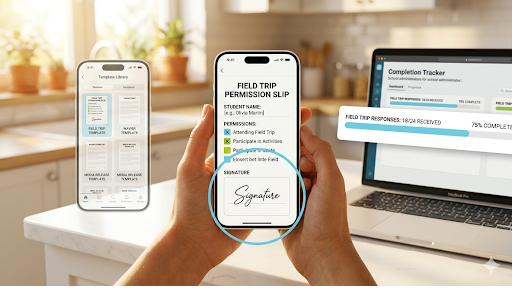
- Forms, RSVPs, conference sign-ups, and the small transactional tasks of a school year live somewhere else, in other tools.
So districts end up with SchoolMessenger for the blast and a patchwork of additional products for the actual relationship. That patchwork is the real cost, and it usually does not show up on the SchoolMessenger invoice.
What a modern district actually needs
Emergency reach is the floor, not the ceiling. A district that wants families genuinely engaged needs the alert and everything around it: a teacher who can message a parent and get a reply, a parent who can read and act in their own language, a behavior record that travels with the student, and the routine forms handled in the same place as the conversation.
Translation is where the gap is widest. SchoolMessenger and similar legacy systems translate the message and stop. Bloomz translates the full application interface into more than 250 languages, with right-to-left mirroring for languages like Arabic and Urdu, so a parent who reads no English can navigate menus, open a form, and sign it without help. We break down why that distinction matters in our piece on message vs full-app translation.
Behavior is the other piece a notification system structurally cannot offer. Bloomz keeps PBIS, behavior tracking, and SEL on the same student record as communication, so a positive point a teacher awards and the message home about it are the same workflow, not two disconnected systems. One platform, in practice, replaces the five to seven tools a district otherwise stitches together. You can see the whole picture on the Bloomz platform overview, and the head-to-head detail on Bloomz vs SchoolMessenger.
And the emergency case still has to be airtight
None of this matters if the district loses confidence in the blast. Bloomz fans a single emergency message across app push, SMS, email, and voice at once, so the urgent reach SchoolMessenger districts rely on is part of the platform rather than a separate purchase. We go deeper on getting that right in emergency notifications that reach every family.
The depth a broadcast tool was never built for
Once you stop treating the alert as the whole job, the list of things a school actually does every day gets long, and none of it looks like a robocall. Bloomz has spent this year building out exactly that side of the platform, and it is the part a notification system has no structural reason to offer.
- Whole-child early warning. Bloomz Thrive reads attendance, behavior, and SEL signals together to flag a student who is starting to slip before it hardens into a pattern, which is a very different thing from mailing an attendance letter after the fact. We walk through the approach in early warning that goes beyond attendance.
- Positive behavior and SEL. House Points and PBIS and routine SEL check-ins live on the same student record as the message home, so recognition and communication are one workflow.
- Anonymous safety reporting. Bloomz BeHeard, now generally available, gives students and families a two-way, anonymous channel to report a concern, covered in anonymous tip lines that actually work.
- Answers grounded in your own content. School Answers is a parent-facing AI that draws only on the school’s own documents, drives, and website, so families get the real policy instead of a phone tree. More in parent-facing AI that answers from your content.
- The transactional year. Fees, recurring tuition, autopay, and teacher payment requests through Bloomz Pay; daily check-in, health, and immunization tracking for childcare; and conference scheduling with interpreter tracking so multilingual families are actually served, detailed in conference dashboards and interpreter tracking.
- Registration and enrollment in the same platform. In the PowerSchool suite that owns SchoolMessenger, enrollment is a separate product with its own purchase. Bloomz builds online registration and enrollment into the platform itself: a public web enrollment page in 250+ languages, sibling data reuse, fee waivers, document upload with expiry tracking, and enrollment data that writes back to your SIS. The family’s first interaction with the district happens in the same place every later conversation will, which is the consolidation argument in miniature.
Who each one fits
Be honest about the match. If your district’s need genuinely begins and ends at fast, reliable one-way alerts, and you are content running separate systems for everything else, SchoolMessenger does the broadcast job and does it well. Some districts are organized exactly that way and have no appetite to change it.
But if you are tired of paying for the alert in one place, two-way messaging in another, translation in a third, and behavior in a fourth, the calculus shifts. The moment engagement, multilingual access, and behavior become priorities rather than nice-to-haves, a single platform that handles the emergency blast and the daily relationship starts to look less like a feature upgrade and more like a consolidation. That is also where the best ParentSquare alternatives conversation usually leads, because the consolidation question is the same one whether you are leaving a robocall system or a modern competitor.
The robocall was the right tool for 2010. Most districts have moved well past needing only an alert, and the systems that still treat the alert as the whole job are showing their age. If you want to see what reliable emergency reach looks like when it sits inside a platform that also carries the conversation, the translation, and the behavior record, schedule a demo.