
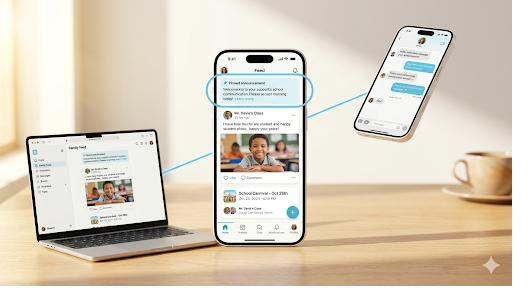
Most districts never decided to run five to seven communication tools. They accumulated them. A mass notification contract here, a translation add-on there, a separate behavior system one principal championed, a forms tool, a website vendor. Each purchase made sense on its own. Added together they form an expensive, overlapping stack that almost no one has ever priced as a whole. This guide shows you how to price it, where the hidden money goes, and how to build the case for consolidating onto one platform.
It is a broad overview rather than a deep dive into any single line item. For the human and operational toll of running disconnected tools, see our piece on the cost of fragmented communication. For squeezing more reach out of constrained funding, see stretching a Title I budget. This guide sits above both and ties the money together.
How districts end up paying for four to seven tools
The pattern is consistent across districts of every size. Communication grows by addition, never by design.
A mass notification system arrives first, usually after an emergency exposed a gap. Translation comes next, often as a paid add-on or a separate service, because the notification tool only handles English well. Behavior and SEL tracking get their own product when a school adopts PBIS. Forms and permission slips live somewhere else again. The district website sits with yet another vendor on its own renewal cycle. Teachers, meanwhile, may be running a classroom app the district never bought.
Five contracts. Five renewal dates. Five support relationships. None of them talking to the others. And the families on the receiving end are juggling several apps and logins to follow one school.
The costs that never show up on a contract
The license fees are the part everyone can see. They are usually the smaller part. The real expense hides in the spaces between the tools.
Staff time switching and reconciling
Every tool is one more place to log in, learn, and check. A teacher who posts an update, sends a separate notification, and logs a behavior note in a third system is paying a switching tax measured in minutes per task and hours per week. Multiply that across a staff and it dwarfs many a license fee.
Duplicate data entry and the errors it breeds
When systems do not share a student record, the same information gets typed in repeatedly. A contact change has to be made in several places or it is wrong somewhere. Every duplicate entry is staff time plus a chance for the error that makes an emergency message miss a family.
Onboarding, training, and support, times five
Each platform brings its own rollout, its own training, its own help desk tickets, its own annual refresher when staff turn over. Five tools mean five onboarding burdens that recur every year, not once.
Integration and IT overhead
Disconnected tools still need rostering, single sign-on, and someone keeping the connections alive. That work is invisible until it breaks, and then it is very visible.
Counting your true total cost of ownership
To compare honestly, add up more than the invoices. A workable total cost of ownership for your communication stack includes the annual license cost of every tool, the staff hours spent switching between them and entering data twice, the recurring training and support load, and the IT time spent maintaining integrations. Put a conservative dollar figure on the time. Even rough numbers usually reveal that the unbilled costs rival or exceed the licenses, and that is the figure consolidation actually moves.
How consolidation lowers cost and friction
Moving these functions onto one platform attacks both halves of the bill at once.
The license side gets simpler because overlapping products collapse into a single subscription, often at a lower combined rate. When pricing is transparent and published, you can model it cleanly. Bloomz, for example, starts at three dollars per student per year and is free for parents, which you can verify against your own enrollment using the Bloomz transparent pricing page rather than waiting on a quote.
The hidden side improves even more. One login replaces several. One student record means a contact is updated once and right everywhere. Messaging, translation, behavior, and forms sit together, so the switching tax largely disappears. Onboarding happens once. Families follow their school in one place instead of several. When communication, translation, and behavior share a record, the duplicate-entry problem stops being a problem.
Why quote-only pricing makes the case harder
There is a budgeting cost to opaque pricing that rarely gets named. When every vendor hides its number behind a sales conversation, you cannot build a clean comparison, and you cannot forecast next year without a phone call. Renewals can move in directions you did not plan for.
Transparent, published, locked pricing changes the exercise. You can put real numbers in a spreadsheet today, model your district at your enrollment, and defend the figure to a board without a single sales call. That predictability is itself a saving, because a budget you can trust is a budget you can plan around.
Building the business case
A consolidation case writes itself once you have done the counting. Lay out the current stack with every tool, its license cost, and its renewal date, so the overlap is visible on one page. Add your honest estimate of the hidden costs: switching time, duplicate entry, repeated onboarding, IT overhead. Then put the single-platform total beside it, license plus a far smaller operational load. The gap is your argument, and it usually points one direction.
Running overlapping point tools feels normal because it grew slowly, but the full cost is larger and quieter than the invoices suggest. Count the hidden hours alongside the licenses, model a single platform against the whole stack, and the business case for consolidation tends to make itself. To see your own numbers against one unified platform, Schedule a demo.