
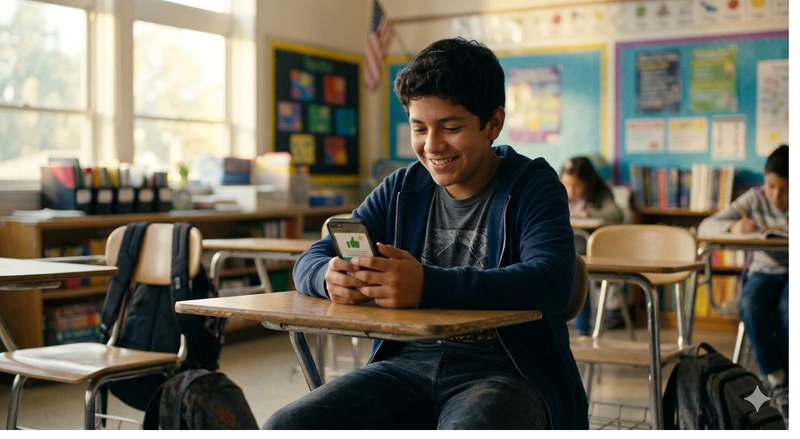
Anonymous reporting is one of the most-requested safety capabilities a district can add, and one of the easiest to get wrong. The market has real, established options, several of them purpose-built and widely deployed. This guide is meant to be even-handed: here is the honest field, here is what actually separates a tip line that works from one that just exists, and here is where an option built into your communication platform fits.
First, the reason any of this matters. The U.S. Secret Service’s National Threat Assessment Center, in its studies of averted school attacks, found that in the large majority of thwarted plots someone knew beforehand — a peer, a friend, a sibling. The information almost always lives inside the student community before an incident. A tip line’s entire job is to give that person a safe, frictionless way to hand it to an adult who can act. Everything below is about how well each option does that one job.
What actually separates good from box-checking
Before the names, the criteria — because the differences between these tools are less about branding and more about design.
- Genuine two-way anonymity. Can a responder ask the anonymous reporter a follow-up question and get an answer, without ever unmasking them? This single capability turns a suggestion box into an investigative tool. It matters more than almost anything else.
- Reachability. Is reporting one or two taps from a device and app students already use, or a separate number and app they have to seek out? Friction kills reporting.
- A closed loop. Does the reporter get an acknowledgment, so the culture of reporting survives past the first few brave students?
- Human routing and escalation. Do reports reach specific trained people with clear escalation paths, fast?
- Tips inform people, not algorithms. This is the trap to avoid: any tool that feeds anonymous reports into a model that scores, ranks, or auto-actions students has automated accusation. Reports should go to trained humans who exercise judgment. Insist on it.
The field
Safe2Tell — A state-run model, most famously Colorado’s, created after Columbine. Where it operates it is well-established, tied into law enforcement and crisis response, and free to schools. It is a program as much as a product, and availability depends on your state.
STOPit Solutions — A widely adopted commercial platform focused on anonymous reporting and threat documentation, with a mobile app and a monitoring/incident-management back end. Mature two-way messaging with reporters. A dedicated tool that lives alongside your other systems.
Anonymous Alerts — Another established, school-specific reporting product, common in K-12, with two-way anonymous communication and configurable routing. Purpose-built and straightforward.
Vector LiveSafe — Part of Vector Solutions’ safety suite; LiveSafe originated in broader community/enterprise safety and is applied to schools, with tip submission and two-way contact. Fits districts already in the Vector ecosystem.
Each of these is a legitimate choice, and a district with a standalone safety mandate and budget for a dedicated tool should evaluate them seriously against the criteria above.
Where a communication-integrated option fits
The dedicated tools share one structural trait: they are a separate system. A separate app for students to find and remember, a separate login for staff, a separate place safety information lives, disconnected from the platform where the school already communicates with families and students every day.
That separation has a cost. The reporting channel students are most likely to use in the moment is the one already on their phone, already open, already familiar — not a safety app they downloaded at an assembly and forgot. When anonymous reporting lives inside the communication platform students and families use daily, it is reachable at the exact moment a student decides to say something, with no separate app to hunt for.
That is the niche Bloomz BeHeard is built for: two-way anonymous reporting inside the app the school community already uses, with tips routed to trained people rather than fed to an algorithm. The trade-off is honest — a district wanting a standalone, law-enforcement-integrated safety program may still prefer a dedicated tool or a state Safe2Tell program. But for schools that want safe reporting to be reachable because it is not a separate thing to remember, integration is the advantage. It also means a concern can surface through more than one door, alongside transparent SEL check-ins and whole-child early warning.
How to choose
- If your state runs Safe2Tell or an equivalent, know what it already provides before buying anything — it may cover the baseline for free.
- If you need a standalone, deeply configurable safety program with law-enforcement integration, evaluate STOPit, Anonymous Alerts, and Vector LiveSafe on two-way anonymity and routing.
- If you want reporting to be used because it lives where students already are, look at an integrated option like BeHeard.
- Whatever you choose, verify two-way anonymity works, the loop closes for the reporter, and — non-negotiable — tips go to trained humans, never to an algorithm that scores kids.
The best tip line is not the one with the most features. It is the one a frightened fourteen-year-old will actually reach for at 10pm, and that puts what they say in front of a person who will act. Judge every option on that. And read our deeper take on what makes an anonymous tip line actually work.