
Part of our PBIS for Districts implementation guide.
When a district shops for PBIS software, the comparison usually runs feature against feature: point systems, behavior tracking, reward stores, reporting dashboards. That is the wrong axis. The decision that shapes whether PBIS actually changes anything is structural. Is the behavior tool a standalone product, or is it built into the platform families already use to hear from the school? Pick wrong and you end up with a system that records points teachers enter and produces reports nobody outside the building ever sees.
What standalone PBIS quietly costs
A standalone behavior platform looks reasonable on a pricing sheet. The real costs show up after rollout, and they tend to be the kind that do not appear in a contract.
A second login and a second contract
Every standalone tool is one more system to procure, one more vendor to manage, one more renewal to budget, one more set of credentials for staff to remember. Teachers already juggle a gradebook, an SIS, and a communication app. Adding a separate behavior tool means another tab, another password, another thing to open during a busy class. Adoption suffers for reasons that have nothing to do with the tool’s quality. A behavior platform that teachers forget to open is just an expensive database of the recognitions they remembered to log.
Recognition that never reaches home
This is the cost that matters most, and it is the one standalone tools are structurally unable to fix. A student earns points for helping a classmate. A teacher logs it. And then it sits inside the behavior platform, visible to staff, invisible to the family. The recognition that should have reached a parent at dinner, the moment that builds the home-school loop PBIS depends on, dies inside a system the family never opens.
PBIS works partly because positive behavior gets reinforced beyond the classroom. When recognition stays trapped in a standalone tool, you have built a points economy that only the school can see. The family never finds out their child was caught doing something right.
Behavior siloed from everything around it
Behavior does not happen in isolation, and it does not mean much in isolation. A student’s behavior pattern is far more legible next to their attendance, their communication history, and what is happening academically. A standalone tool fences behavior off into its own database. To understand a student, a counselor or administrator has to cross-reference the behavior platform against the SIS against the communication log, by hand. The connections that would actually help a kid are the ones nobody has time to assemble manually.
What integration changes
When PBIS lives on the same platform families already use, the same actions produce different outcomes, because the recognition has somewhere to go.
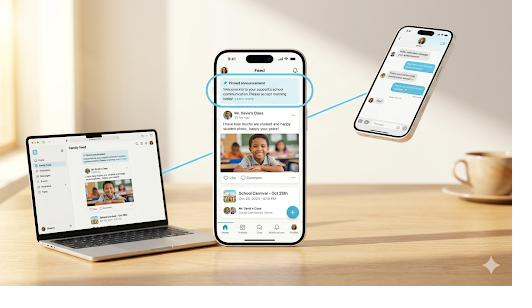
A teacher logs positive behavior, and the parent gets notified, in their language, the same day. The win reaches home while it still means something. There is no second system, no separate login, no manual step to “share it with the family,” because the behavior tool and the family communication tool are the same tool.
Behavior also lands on the same student record as attendance and communication. When a pattern starts to form, an administrator sees the behavior notes, the attendance trend, and the family-contact history on one timeline instead of three. That is what makes early intervention realistic rather than aspirational. The data that supports a decision is already sitting together.
Bloomz attendance, behavior, and SEL is built on exactly this premise. Behavior and SEL live on the same student record as attendance, and recognition reaches families through the communication platform they already use, translated into their language automatically. The work of getting a positive moment from a teacher’s classroom to a parent’s phone is not a workflow someone has to remember. It is the default.
The flip side, paying for a standalone PBIS tool on top of a communication platform that should have included behavior, is its own line item. We break down that math in our post on the double charge of a separate PBIS tool.
An evaluation checklist
When you put a PBIS option in front of your team, run it through these questions before you look at the feature grid.
- Does recognition reach families automatically? When a teacher logs positive behavior, does a parent get notified without a separate manual step, and in their own language?
- One login or two? Will teachers log behavior in the same place they handle family communication, or open a separate app?
- One contract or two? Is behavior included in your communication platform, or a second line item with its own renewal and its own vendor?
- Is behavior on the same record as attendance and communication? Can an administrator see behavior, attendance, and contact history on one student timeline, or are they scattered across systems?
- Does recognition translate? If a third of your families speak a language other than English, does the positive note actually reach them in a language they read?
- What is the real adoption picture? A tool teachers skip because it is one more tab produces no data worth analyzing. Which option is a teacher more likely to actually use?
A standalone tool can win the feature comparison and still lose where it counts, because the features were never the constraint. Reach was. The question to settle first is whether a positive moment makes it from a classroom to a kitchen table, and an integrated platform answers that by design while a standalone one leaves it to a staff member’s memory.
To see behavior, SEL, and family communication working on one student record, schedule a demo.