Ask a childcare director what they need from software and you’ll get a fast, specific list: daily reports, photo sharing, tuition billing, check-in and check-out. Brightwheel and Procare answer that list well. They are mature, well-liked, purpose-built platforms for the daycare and preschool years, and a program that will only ever be a daycare or preschool can pick either one and be genuinely well served.
This isn’t a piece about which childcare app has more features. It’s about a question that a feature checklist can’t capture, because it happens after the checklist stops mattering: what happens to the family relationship when the child ages out?
The trait every childcare app in the category shares
Brightwheel, Procare, and the other established names in this space are early-learning platforms. Their world runs from infancy through pre-K, sometimes a little further. That’s not a weakness — it’s focus, and focus is exactly why they’re good at what they do. But it means the software’s scope and the family’s relationship with the program end at roughly the same moment. When a child ages out, the family ages out of the app too.
For a standalone daycare that will never be anything but a daycare, that’s someone else’s problem. For a program that spans into elementary grades, a district running both early learning and K-12, or a childcare center that would like to keep the families it worked hard to earn, the handoff is the whole problem — and no amount of polish on the daily-report screen fixes it.
What continuity actually requires
Continuity isn’t a bigger feature list bolted onto a childcare app. It’s a different shape of platform: one that has to be genuinely good at licensed-childcare operations and keep going into K-12 without asking the family to start over.
On the early-learning side, that means the unglamorous, compliance-grade basics have to be real: kiosk check-in with a PIN or QR code, guardian signatures, daily health screening, staff-ratio tracking, and CDC-schedule immunization tracking that survives a licensing audit. Bloomz’s Check-In/Out module covers exactly that ground — deliberately not more, and not less.
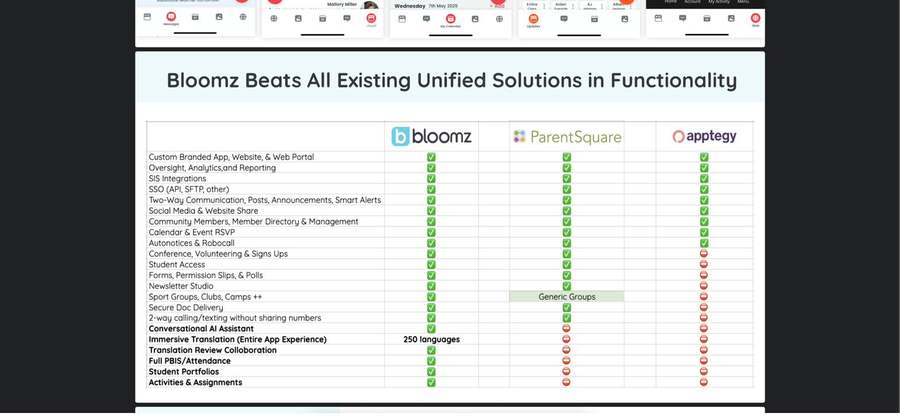
On the language side, it means the whole interface, not just the daily report, renders in the family’s language. A translated activity feed is a nice-to-have. A kindergarten enrollment form, a behavior note two years later, a conference invitation five years after that — readable without a translated PDF or a bilingual staff member standing by — is the relationship. Bloomz translates the full app across 250+ languages, including right-to-left layouts, from the first drop-off through graduation.
And on the billing side, it means one relationship instead of two: recurring tuition, autopay, and subsidy-agency billing for the childcare years, carried into the same account that later handles K-12 fees and teacher payment requests.
What this claim is not
It’s worth being precise about what “continuity” does and doesn’t mean, because it’s easy to overstate. This is not a claim that Bloomz replaces every specialized childcare-operations tool, or that it does more center-management work than Brightwheel or Procare on their own turf — a program with heavier CACFP food-program tracking or curriculum/assessment needs may still find a childcare-only specialist deeper on those specific fronts. What Bloomz claims is narrower and, we think, more useful for the right reader: it’s the only platform built so the relationship survives the age-out point that ends every other childcare app’s usefulness.
Where this matters most
The reader this piece is for isn’t the standalone daycare down the street — that program is well served by a childcare specialist and should stay there. It’s the program with elementary grades already attached, the district weighing whether to run early learning and K-12 on separate systems, or the childcare center that has started asking why it keeps losing touch with families the moment they’re no longer paying tuition.
For that reader, the deciding question isn’t “which app has the better daily report.” It’s “which platform doesn’t make my families start over.” A parent who gets checked in at two years old, health-screened all through preschool, and then reads a same-day absence notice, a PBIS recognition message, and a ninth-grade conference invitation — all on the same account, in the same language — never has to relearn anything. See how Bloomz carries a family from childcare through 12th grade, or read the fuller feature-by-feature comparison in Bloomz vs. Brightwheel.